Mr Maple Canada
Launch promo ends in 00:00:00
Get the Book — $14.99
First edition · Coast to coast to coast · 204 sites

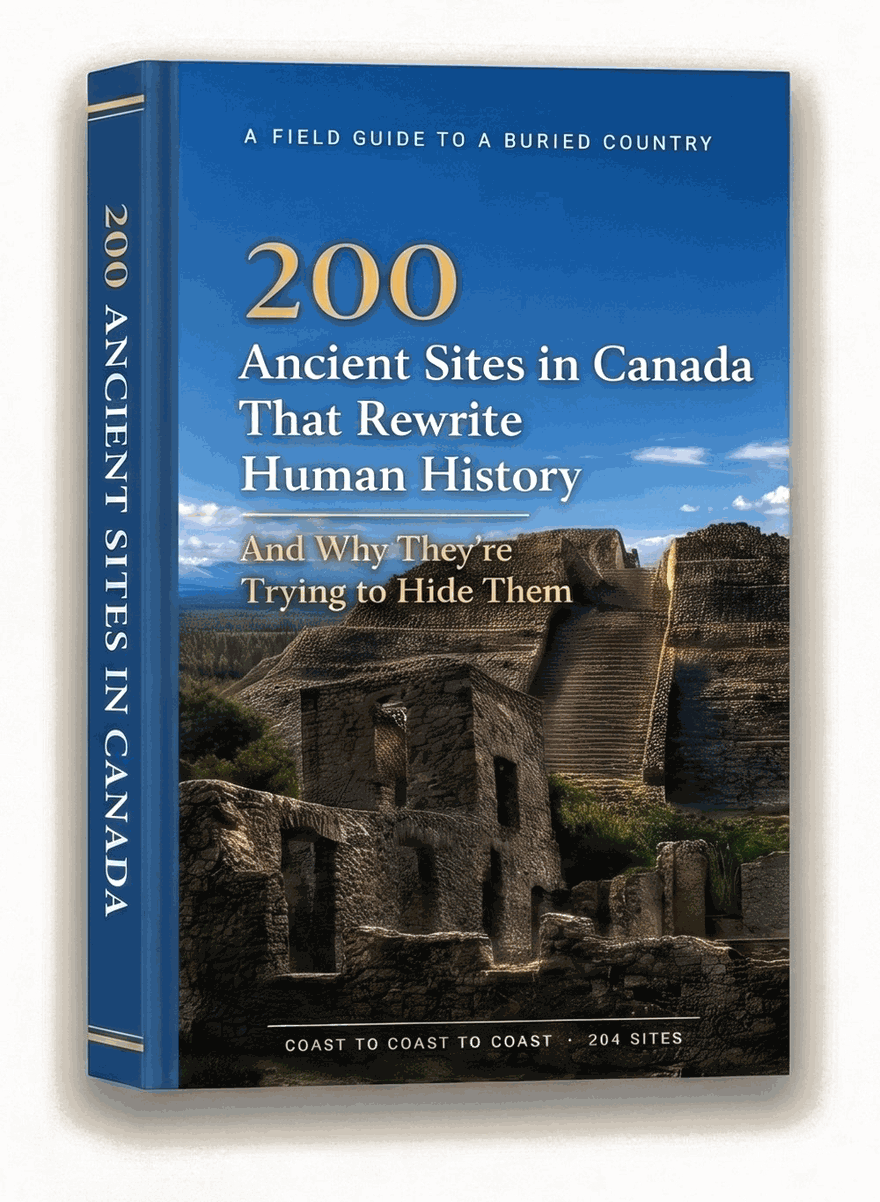
200 Ancient Sites in CanadaThat Rewrite Human History

And Why They're Trying to Hide Them

Two hundred and four archaeological sites across all thirteen provinces and territories, from the Bluefish Caves in the Yukon to the Newfoundland coast. Every entry gives the place, the date, what was found there, and the specific, documented reason you have never heard of it.

  • 204 sites, every province and territory — Yukon 12, BC 31, Ontario 25, Quebec 17, Newfoundland & Labrador 20 and the rest, each with location, approximate age and what was actually found.
  • Bluefish Caves, c. 24,000 BP — the site that broke Clovis First, and the archaeologist dismissed for thirty-five years before he was proved right.
  • Six documented mechanisms of burial — closed provincial databases, routine redaction of site locations, compliance digs nobody reads, hydro flooding, an enforced timeline, and the curriculum.
  • Part Three is the method — Borden numbers, graduate theses, freedom-of-information requests, free public LiDAR in QGIS and nineteenth-century survey maps, so you are not dependent on anyone's catalogue. Including this one.
  • 203 pages, illustrated, fully sourced — drawn from published archaeological literature, government heritage policy and mainstream reporting. Contested dates are flagged where they occur.
$14.99Instant PDF
Get the Book — $14.99
Instant download · Yours forever
VisaMastercardAmexPayPalApple Pay
200 Ancient Sites in Canada That Rewrite Human History — A Field Guide to a Buried Country
204Sites catalogued
13Provinces & territories
203Illustrated pages
24,000Years of record

Real Voices

“I grew up forty minutes from Debert and never once heard it was eleven thousand years old. The entry told me why in three lines — found during a military build in the 1940s, and closed to the public ever since.”

Dwayne Arsenault Dwayne Arsenault61, Miramichi, New Brunswick

“The chapter on redaction is the one that got me. I requested a permit report the week I finished the book, it came back with the coordinates stripped exactly as described, and I still found the paper behind it.”

Marisa Thibodeau Marisa Thibodeau44, Kamloops, British Columbia

“Part Three earned the price on its own. Borden numbers, then the theses, then hillshading free LiDAR in QGIS. I have two rectangular depressions under canopy north of me that are worth a second look.”

Gordon Fiske Gordon Fiske57, Thunder Bay, Ontario
4.9 / 5 stars · over 8,000 readers of the record
Get the Book — $14.99
Instant download · Yours forever
The claim

Canada does hide its ancient sites. It does so openly, legally, and at scale.

You are going to read a great deal, online and in print, about ancient sites in Canada being hidden. Most of it is nonsense — vanished civilisations, giants, secret orders, buried spacecraft. That material is worth nothing to you, because none of it survives ten minutes of checking.

The real story is stranger and considerably better documented, and the responsible governments publish it themselves.

Every province and territory keeps an inventory of recorded archaeological sites, indexed by Borden number. In British Columbia the RAAD portal is updated weekly and open to consultants, First Nations, accredited researchers and planning agencies. Everyone else submits an information request. In Ontario, the ministry's stated position is that site locations are not public, and reports are scrubbed of them under provincial privacy law before release. The reasoning is defensible. The effect is that the archaeological map of Canada is a professional document, not a public one.

You can obtain a document that describes a discovery in detail while being legally prevented from learning where it happened. For a great many Canadian sites, that redacted report is the only public record that they were ever found.

Then there is water. Hydroelectric development has drowned more Canadian archaeology than any other single force — river valleys are exactly where people lived, and exactly what you flood to make a reservoir. The Site C dam alone put 337 recorded sites in an inundation zone holding roughly twelve thousand years of human presence.

And there is the timeline. For forty years Clovis First functioned less as a hypothesis than as a boundary, and being right early was professionally expensive. Jacques Cinq-Mars published the Bluefish Caves dates from 1979 onward and was dismissed for three decades. In 2017 a doctoral student re-examined the bone assemblage with modern methods. The cut marks were real. The dates were real. He had been right the entire time, and he died a few years after the vindication.

This book is the catalogue nobody publishes — 204 sites, what each one is, and the specific reason it stayed out of view. Then it hands you the method, so you can go and find the rest.

The difference

Why this is not another hidden-history book

The genre has a credibility problem, and it earned it. Here is the line this book draws, and keeps.

 200 Ancient Sites in CanadaThe usual hidden-history material
Where the claims come fromPublished archaeological literature, provincial heritage policy documents and mainstream reporting — listed in the Sources chapter so you can check any of themRetellings of retellings, with no traceable origin
Who built themThe ancestors of the Indigenous peoples of this land, stated plainly on page four. The alternative has no archaeological support and a long history of being used to justify dispossessionLost white civilisations, giants, visitors
What “hidden” meansClosed databases, redacted coordinates, flooded valleys, an enforced timeline and a curriculum that starts at 1497 — every one of them verifiableAn unnamed organisation, motive unstated
Locating a siteBorden numbers, real place names, approximate dates, and a note where a site is closed or on protected land“Somewhere in the north”
Contested evidenceFlagged as contested where it is contested — Sheguiandah and the Whiteshell petroforms among themPresented as settled fact
Coverage204 entries across all thirteen provinces and territoriesThe same five famous sites, repeatedly
What you can do nextA six-step method: Borden numbers, theses, permit reports, freedom of information, public LiDAR, historic mapsNothing. The story ends where the video does
What's inside

203 pages, and here is every part of it

The real table of contents, with page numbers, exactly as it appears in the book.

Introduction · page 7

The Man They Called a Crank

Old Crow, Yukon, 1994. Jacques Cinq-Mars waiting at the airstrip, fifteen years into being told he was wrong about the most important thing he had ever found — three limestone hollows holding butchered horse and mammoth bone at roughly 24,000 years before present. How a discipline can be wrong for a very long time, and what that costs the person who is right early.

Part One · page 15

Six Ways a Country Buries Its Own History

  • 1 · The database you are not allowed to open — the Borden system, RAAD, PastPort, and who is eligible
  • 2 · Redaction as routine — what actually arrives when you request a permit report
  • 3 · Development archaeology and the reports nobody reads — Draper, and the Mantle site under a subdivision
  • 4 · Water — Site C, W.A.C. Bennett, the Churchill River Diversion, James Bay
  • 5 · The enforcement of a timeline — Clovis First, Old Crow and Sheguiandah
  • 6 · The curriculum — why Canadian school history begins, in practice, in 1497
Part Two · page 23 · 204 entries

The Sites

Each entry gives the location, the approximate age, what the site actually is, and a short section headed Why you haven't heard of it. Bluefish Caves, the Calvert Island footprints, Triquet Island, Wally's Beach, Head-Smashed-In, Wanuskewin, the Gray Burial Site, the Whiteshell petroforms, Kinomagewapkong, Pointe-du-Buisson, Droulers-Tsiionhiakwatha, Debert, L'Anse aux Meadows, L'Anse Amour — and one hundred and ninety more.

  • Yukon 12
  • Northwest Territories 10
  • Nunavut 12
  • British Columbia 31
  • Alberta 20
  • Saskatchewan 16
  • Manitoba 13
  • Ontario 25
  • Quebec 17
  • New Brunswick 10
  • Nova Scotia 12
  • Prince Edward Island 6
  • Newfoundland & Labrador 20
Part Three · page 193

How to Find Them Yourself

  • Step 1 · Learn the Borden system — four letters and a number, and what they encode
  • Step 2 · Mine the theses — the single most underused resource in Canadian archaeology
  • Step 3 · Request the reports — where to write in BC and Ontario, and what survives redaction
  • Step 4 · Use freedom-of-information legislation properly — name the record, and ask about informal release first
  • Step 5 · Read the ground with public LiDAR — federal HRDEM and provincial portals, hillshaded in QGIS
  • Step 6 · Read the old maps — county atlases, GSC plans, and features marked in 1880 that are gone today
Sources · page 199

Sources and Further Reading

The principal starting points for checking any claim in the book — including the 2017 Bourgeon, Burke and Higham paper that confirmed the Bluefish Caves dating, British Columbia's Archaeological Information Access Policy, Ontario's PastPort documentation, and Parks Canada's guidance on Borden number practice.

Get the Book — $14.99 Instant download · 203 illustrated pages · PDF, readable on any device
About

Mr Maple Canada

This is a channel about the part of Canadian history that starts long before 1497 — the towns, quarries, fish traps, medicine wheels and burial mounds that are documented in the professional record and almost entirely absent from the public one.

The rule here is simple, and it is why the book takes the shape it does: every claim has to be checkable. If a date is contested, the entry says so. If a site is closed to visitors or sits on reserve or private land, the entry says that too. Nothing in this book is permission to visit or to dig, and it says so on page four.

It also rejects, entirely and by name, the claim that these sites were built by anyone other than the ancestors of the Indigenous peoples of this land. That idea has no archaeological support and a long history of being used to justify dispossession. A book about a buried country has no business adding to the burial.

What is left after all of that is still remarkable. Maize grown and stored at Lockport on the Red River about a thousand years ago, well north of where prairie agriculture is usually placed. Tens of thousands of stakes in the Comox fish traps. Clam gardens on the BC coast deliberately engineered to raise shellfish yields. Ramah chert from northern Labrador travelling thousands of kilometres down the eastern seaboard. The Majorville Medicine Wheel, begun about five thousand years ago and maintained for millennia — older than Stonehenge.

None of it is secret. All of it is published. It is simply not taught, and the practical difference between a fact that is suppressed and a fact that is never mentioned is close to zero.

Questions

Before you buy

Is this another lost-civilisation book?

No, and it argues against that material directly. Page four states that the book rejects entirely the claim that these sites were built by anyone other than the ancestors of the Indigenous peoples of this land.

“Trying to hide them” is used in a precise, verifiable sense: provincial archaeological databases are formally closed to the public, site locations are stripped from reports before release under privacy law, hundreds of sites have been flooded, paved and quarried with regulatory approval, and findings that contradicted the accepted timeline were dismissed for decades. Every one of those statements is sourced in the book.

Your videos are free. Why buy this?

A video gives you one site and about eight minutes. This is 204 of them in one place, indexed by province, with the date, the find and the reason it stayed quiet on every entry — the thing a video cannot do, which is let you look something up.

It also includes Part Three, which is not in any video: the six-step method for finding sites yourself, from Borden numbers through freedom-of-information requests to hillshading free public LiDAR in QGIS.

Why only $14.99 for 203 pages?

Because it is a PDF. There is no printing, no shipping and no retailer taking a cut, so the price can be the work rather than the object.

And the work was in the assembling — reading theses, permit report summaries, heritage policy documents and published papers until 204 entries could each be checked. $14.99 is the launch price for the first edition.

What format is it, and how do I get it?

A single illustrated PDF, 203 pages, delivered by Gumroad the moment payment clears. It opens on a phone, a tablet, a laptop or an e-reader, and it is yours to keep and re-download.

There is no app, no subscription and no login to maintain.

Can I visit the sites in the book?

Some, yes — Head-Smashed-In, Wanuskewin, Kinomagewapkong and L'Anse aux Meadows among them are open, interpreted, and worth the drive.

Many are not. Sites that are closed, on private or reserve land, or restricted at the request of the communities whose ancestors lie in them are marked as such. The book is a record, not an invitation to dig, and it is explicit about that.

How solid are the dates and the numbers?

Dates are approximate, drawn from published literature, and contested chronologies are flagged where they occur.

Where a reversal is part of the story the book tells you that too — the Old Crow caribou-bone flesher was once dated far beyond the accepted range and then redated to roughly 1,400 years old. That correction was legitimate science, and it was also used for years afterwards to dismiss unrelated northern sites, including Bluefish.

Is there more than one book?

Not yet. This is the first edition, and it is the whole thing — Introduction, Part One, all 204 entries, Part Three and the Sources chapter in a single file. Nothing is held back for a volume two.

Coast to coast to coast

The database is closed to the public. The sources are not.

204 sites, thirteen provinces and territories, 203 illustrated pages — and the method to find the rest yourself.

$14.99Instant PDF
Get the Book — $14.99
Instant download · Yours forever
VisaMastercardAmexPayPalApple Pay